How Does the I Ching Work?
How the I Ching actually works, layer by layer: a randomizing procedure, a 64-hexagram lookup, a classical text — and where the meaning really comes from.
Three layers, cleanly separated
Strip away the incense and the I Ching decomposes into three layers, each perfectly legible: a randomizing procedure (coins, yarrow stalks, or a modern input, producing six numbers), a lookup (six numbers select one of 64 hexagrams), and a classical text (every hexagram and every line maps to writing transmitted for nearly three thousand years). Most of the mystique comes from blurring the three together; kept apart, it's much easier to see why the thing has lasted.
Layer 1: drawing the numbers
Every casting method is ultimately a way to draw one number (6, 7, 8, or 9) for each of six line positions. The coin method tosses three coins six times — old yin, young yang, young yin, old yang land with probabilities 1/8, 3/8, 3/8, 1/8. The yarrow stalk method runs eighteen divisions and produces a deliberately asymmetric distribution (old yin 1/16, young yang 5/16, young yin 7/16, old yang 3/16). Plum Blossom casting takes moduli of a time or two numbers. The modern methods push the bytes of text, music, or an image through a SHA-256 digest. All of it is arithmetic you can recompute — the math page has the full derivations.
Layer 2: from six numbers to a hexagram
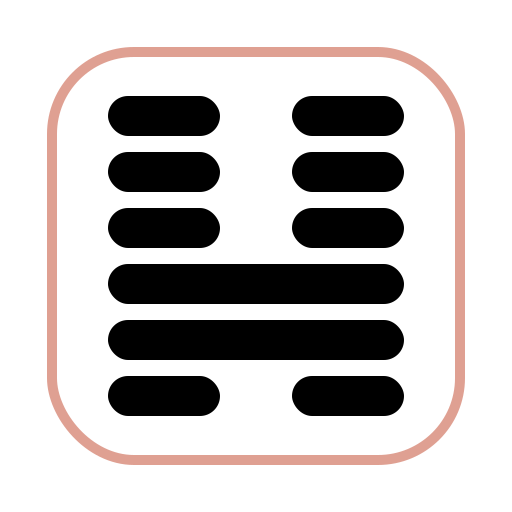
Odd numbers become solid yang lines (—), even numbers broken yin lines (--), stacked bottom to top. Six binary positions give 2⁶ = 64 combinations — that is the entire origin of “the 64 hexagrams.” The lower three and upper three lines also form two of the eight trigrams — heaven, lake, fire, thunder, wind, water, mountain, earth — stacked in pairs. There is nothing occult at this layer: it's a binary encoding from three millennia ago, covered in detail in the 64-hexagram guide.
Layer 3: moving lines and the changed hexagram
Among the drawn numbers, 6 and 9 are moving: their lines flip, transforming the primary hexagram into a second one. So a reading's answer isn't a static figure but a trajectory — the present situation (primary hexagram), the point where it's loosening (moving line), and the direction it's tending (changed hexagram). It's the most elegant part of the structure; see what changing lines are.
Layer 4: the text
Each hexagram carries a judgment and each line its own line text — the core Zhouyi — wrapped in the commentary layers of the Ten Wings (the Tuan and Image commentaries among them). The text is old, its imagery deliberately neutral: it names no one, which is precisely why each questioner can pour their own situation into it. We display the classical original and the plain reading as separate layers, cite the commentary lineage, and never mix in invented “master's verdicts.”
So where does the meaning come from?
The honest answer: from you. The randomizing (or deterministic) procedure guarantees the hexagram owes nothing to your expectations; the ancient text supplies imagery rich enough and neutral enough to think with; and what connects the two is the moment you read it while holding a real question. That isn't a flaw — it's the working principle of a reflection instrument. See is the I Ching real? and how accurate is the I Ching?.