Kan · Water
Overview
— Three-line symbol
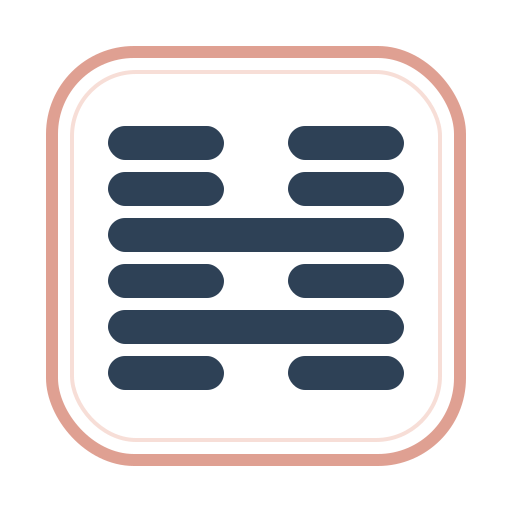
Kan places one yang line between two yin lines (010). Its natural image is water. The shape is open outside and solid at the center: a single firm line sunk between two broken ones, like water running in the depth of a ravine — one point of substance inside a hazardous surround. The Shuogua names its virtue xian (陷): the pit, sinking into danger. Kan is the trigram that faces difficulty directly.
In the trigram family Kan is the middle son, the second son 'obtained' from Qian. The King Wen arrangement places Kan due north, matched to deep winter; the Shuogua says 'there is toil at Kan' — it is where the ten thousand things, spent from the year's work, return and rest, as water returns to its hollows. The Fuxi arrangement places Kan due west.
Kan's classical images include channels and ditches, the hidden and lurking, the bent-and-straightened, bow and wheel, anxiety, heart trouble, earache, the trigram of blood, the moon, the thief — plus the fine-spined restless horse, the wagon that keeps breaking down, and wood hard at the core. Danger, toil, concealment, worry — yet Kan's teaching does not stop at hazard. Water meets obstruction without changing its nature: it fills each hollow completely, then moves on. Hence the judgment of the doubled hexagram: in repeated danger, sincerity and an unblocked heart carry you through.
Trigram Virtue
— Shuogua · the defining quality
The pit (陷 xian)
Xian means being inside difficulty. But Kan's middle line is solid: within the danger there is one point that does not sink. Water is its teacher — it does not avoid the low place or the obstacle; it flows according to its own nature, fills one hollow, and proceeds to the next. Kan counsels facing hardship squarely, holding to inner sincerity and steadiness, and crossing the danger by sustained effort rather than by luck or detour.
Classical Source
— Shuogua zhuan (Explaining the Trigrams)
Line Structure
— Bottom to top
Bottom to top: yin, yang, yin (010). One solid line holds the center, hemmed in by broken lines above and below: substance within, openness without — the exact mirror of Li. This structure is Kan's whole teaching: the surrounding conditions are pitted with hazard, yet the center holds one unextinguished point of firmness. Keep that inner solidity and the danger can be crossed; lose it and the sinking becomes real.
In a Reading
— As upper · as lower · overall
As the lower (inner) trigram
As the lower (inner) trigram, Kan marks inner worry and toil: anxiety, doubt, or unspoken pressure circling beneath the surface. Settle the heart first — the solid middle line is the reminder that inner sincerity and steadiness are your footing now. Do not let dread become the decision-maker.
As the upper (outer) trigram
As the upper (outer) trigram, Kan marks obstruction or deep water ahead: the road is blocked, conditions are murky, or you are wading into genuine complexity. Take water as the method — no forcing, no gambling; sound the depth, fill each hollow before advancing. And keep your word: nothing costs more in danger than lost trust.
Overall
Kan governs danger, toil, and movement through the depths. Meeting it usually signals hazardous ground or a necessary crossing; its method is the judgment's own — sincerity, and a heart that stays unblocked, carried by steady practice. Doubled, Kan forms Hexagram 29, 'the repeated pit,' whose theme is exactly this: rehearsing the crossing until danger itself becomes the training.
Hexagrams Containing Kan
— Kan as upper or lower trigram
· English renderings and modern readings are original editorial writing, cross-checked against public-domain and classical commentary lineages.
· Hexagram Cast does not predict, score, schedule, ward, or recommend rituals.
· Modern inputs are reproducible; traditional casts can be audited line by line from the stored coin/yarrow trace.